How Does Laparoscopy Help in Infertility Treatment?
Introduction
Have you ever wondered why some couples struggle to conceive despite everything looking “normal” on the surface? Infertility can be a frustrating and emotional journey—but thankfully, medical science offers hope in many forms. One such method is laparoscopy, a minimally invasive procedure that often holds the key to unlocking fertility mysteries.
In simple terms, laparoscopy allows doctors to take a direct look inside the body to identify and sometimes fix the issues that prevent pregnancy. It's like having a camera peek inside the hidden parts of a car engine to figure out why it won’t start—without taking the whole car apart!
Discover how laparoscopy boosts fertility and why consulting the best IVF doctor in New Delhi can transform your parenthood journey.
Let’s explore how this powerful diagnostic and treatment tool plays a vital role in helping couples conceive—especially when combined with the expertise of the best IVF doctor in New Delhi.
What is Laparoscopy?
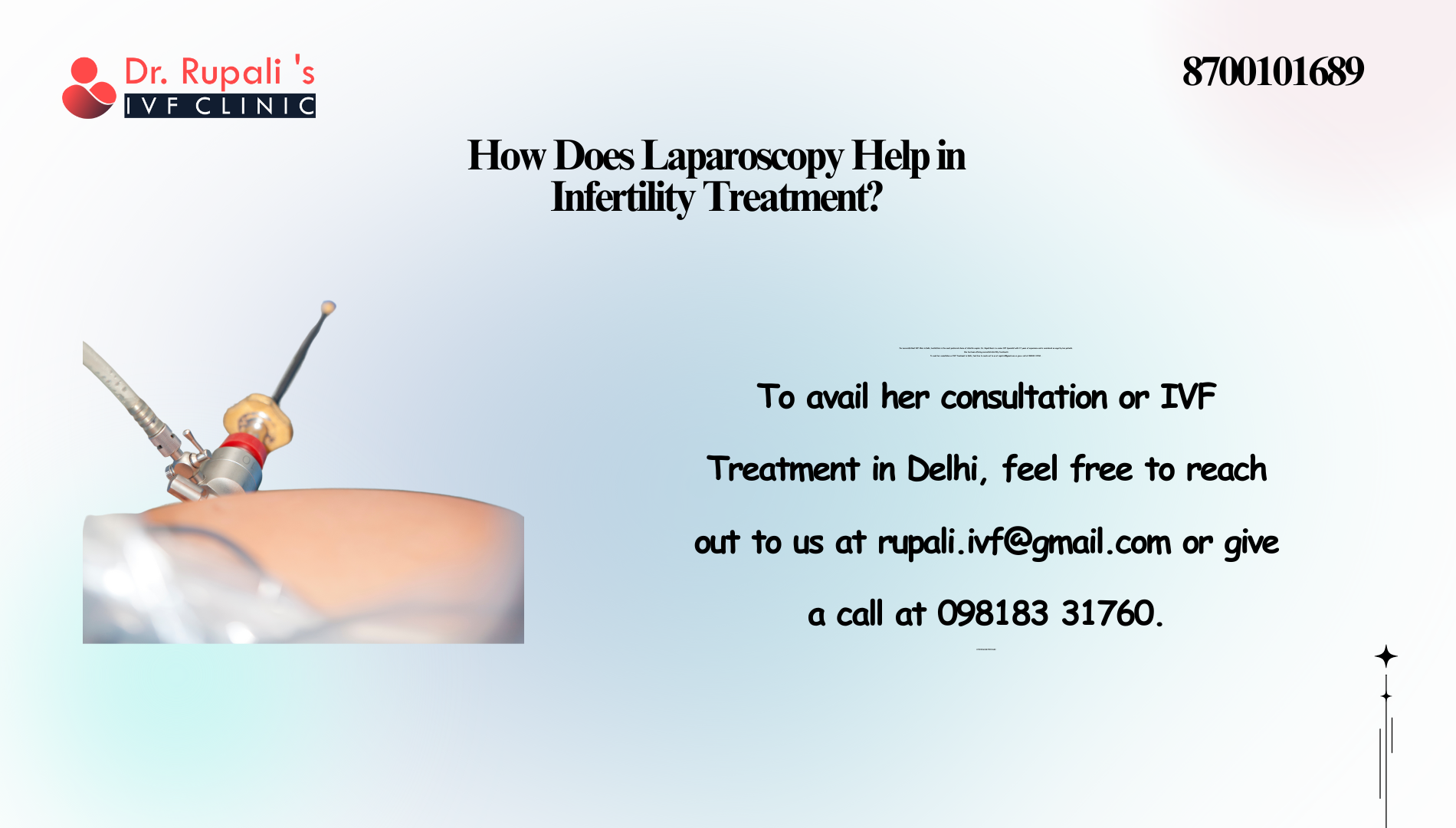
Laparoscopy is a surgical technique wherein a tiny camera is placed through small incisions in the abdomen so as to view the bottom half of the body. It assists in inspecting the uterus, ovaries, and fallopian tubes.
With laparoscopy, the pain is significantly reduced and the recovery time is shorter compared to traditional surgeries which make larger cuts to the body. Moreover, laparoscopy leaves a laparoscopy scar. That is the reason why it is often referred to as laparoscopy “keyhole surgery.”
Used in Infertility Why is Laparoscopy?
Because of the unrecognized hidden issues, infertility can sometimes occur. These problems are often missed by using routine imaging procedures like ultrasounds. Laparoscopy can uncover a multitude of hidden issues, both internal and external, and blockages, scarring, or tissue damage that could exist and that would make conceiving a challenge.
In simple words, practically, it’s like turning on a flashlight inside of a cupboard filled with files and letting it illuminate everything inside so that one is able to see, witnessing everything that’s happening within.
How is Laparoscopy Performed?
Like with most surgical procedures, laparoscopy is conducted only after general anesthesia has been administered. The surgical staff will start by making a small cut around the navel region. They will blow carbon dioxide gas into the abdomen to give a better view of the area. A laparoscope (tiny camera) is then injected allowing the physician to view as well as treat certain conditions in the same visit.
Laparoscopy is an outpatient procedure, meaning you can usually return home the same day and almost always the following day. The time it takes to recover is short compared to many other procedures.
- When is Laparoscopy Recommended in Fertility Cases?
The most common recommendations from doctors suggest laparoscopic surgery if:
You’ve tried achieving pregnancy for over a year with no success, You experience menstrual cycles which inflict pain or pelvic pain, You have previously undergone imaging tests which showed no cause but persisting symptoms are pointing to one, IVF has been attempted but was unsuccessful and there is no obvious reason as to why.
- Conditions Diagnosed Through Laparoscopy Some conditions which cannot be diagnosed through an ultrasound can be laparoscoped. Some of them include:
Endometriosis, Pelvic adhesions (scar tissue) Blocked fallopian tubes Ovarian cysts Uterine abnormalities In diagnosing some of these ailments laparoscopic surgery can convert the procedure into both a surgery and a diagnosis.
- Treating Endometriosis with Laparoscopy When tissue like that of the uterus grows outwards, it causes endometriosis. This specific condition is lethal due to its ability to cause pain, inflammation, and even obesity.
Laparoscopic surgery is said to be the best way to capture images and treat endometriosis. The surgeon removes or burns abnormal tissues so that chances of natural conception or IVF will be greatly improved.
- Removing Blockages from Fallopian Tubes Using Laparoscopy
One of the leading causes of infertility is blocked or damaged fallopian tubes. Using laparoscopy, doctors can:
Locate areas of blockage or kinking in the tubes.
Free up scar tissue.
Reopen some of the blocked tubules.
This can enhance natural fertility and improve the results of assisted reproductive methods.
- Identifying Ovarian Cysts and Fibroids
Cysts and fibroids can also disrupt ovulation and implantation. During laparoscopy, physicians can:
Extract ovarian cysts.
Remove or reduce fibroids.
Collect tissues for laboratory examinations.
This helps to guarantee that the reproductive system is in the most prepared state for conception.
- Importance of Laparoscopy Examination Before IVF Procedure
Prior to commencing IVF, some fertility experts order laparoscopy to:
Check for any underlying concerns.
Verify that the uterus and tubes are in good working order.
Resolve problems such as fibroids or adhesions.
These improve the chances of IVF success, particularly in patients with undiagnosed infertility.
- Differentiating Between Hysteroscopy and Laparoscopy
Both are considered minimally invasive, however:
Laparoscopy examines the abdominal cavity and parts of the organs externally.
Hysteroscopy examines the interior of the uterus through the vaginal canal.
They are commonly paired for a full fertility assessment.
- Risks and Recovery After Laparoscopy
Laparoscopy surgery is generally safe; however, like any surgery, it has its risks – however small – which include:
Infection Ailment Bleeding Complications from anesthesia
Most people recover quickly, within a week, and return to their everyday activities.
- Success Stories: Real Impact on Fertility
Many couples are able to conceive after years of unsuccessful attempts due to a diagnostic laparoscopy. For many expectant parents, we can imagine what laparoscopy feels like. It’s like finding a missing puzzle piece.
- Cost and Accessibility in India
Laparoscopy is cost-effective and widely accessible in India. Depending on the hospital, city, and complexity, costs can range from ₹25,000 to ₹70,000.
Consulting with New Delhil’s best IVF doctor guarantees top-notch comprehensive care while helping figure out if this is the right step towards parenthood.
- Why Choose the Best IVF Doctor in New Delhi
The best IVF doctor in New Delhi, as well as the rest of India, can provide exceptional expert care. These doctors laparoscopy not only by combining it with IVF but also tailoring it to the needs of the patient.
When you choose wisely, laparoscopy aids in the accurate diagnosis of fertility problems, ensuring world-class compassion and care free of frustration.
- Concluding Remarks and Future Actions
Trying to balance out the difficulty of infertility can be very challenging, however, employing laparoscopy can simplify the path forward. Using laparoscopy on its own doesn’t guarantee pregnancy, however, the odds are greatly improved and even more so when combined with IVF or other fertility therapies.
If you or a loved one is trying to resolve fertility issues, consult with a fertility professional. Laparoscopy may just be the procedure that changes everything for you.
Commonly asked questions...
.
- After infertility treatment, is laparoscopy painful?
Every laparoscopic procedure is performed with anesthesia; thus, there is no pain felt during the surgery. Pain is not present during the procedure, however, some participants report feeling mild discomfort during recovery.
- How long does it take to recover after undergoing laparoscopy?
Most patients recover post surgery within in 3 - 7 days. All activities can be resumed to within a week.
- Will laparoscopy improve my chances of getting pregnant naturally?
Yes, a great number of women can now get pregnant naturally after undergoing laparoscopy, particularly if they take care of the endometriotic blockades or blocked tubes.
- Laparoscopy is performed, do I have to undergo IVF now?
Not necessarily. Conceiving is possible to some women after laparoscopy, while others may require IVF therapy depending on the diagnosis.
- How do I find the best IVF doctor in New Delhi?
Pay attention to reviews written by patients as well as the success stories. Look for advanced laparoscopic services offered by the doctor. It is important to consider attending an initial consultation.


